

The language industry has changed dramatically over the last few years.
While translation and interpreting remain at the core of many professionals’ careers, clients today are increasingly looking for specialists who can support broader multilingual workflows: localization, content adaptation, terminology management, linguistic validation, consulting, project management, and much more.
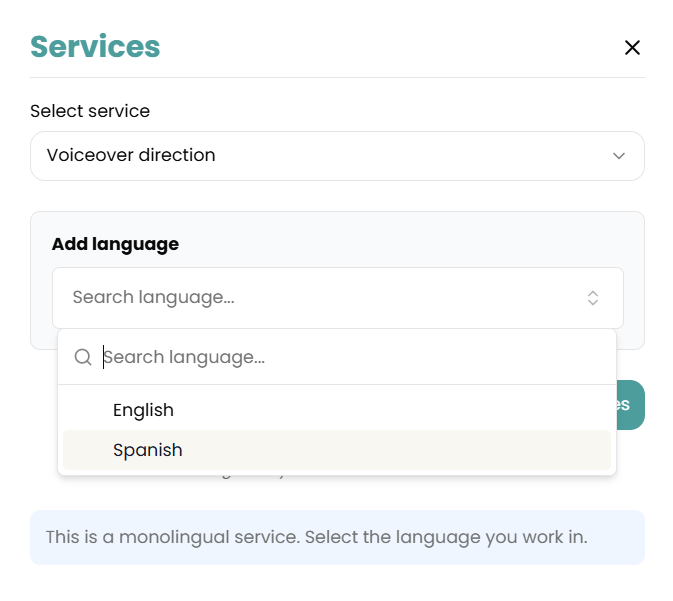
To help professionals better represent the services they offer —and help clients find the right specialists more easily— we’ve expanded and refined the services available in ProZ profiles.
Some of these services were already available on the site but can now be reported in a more accurate way, making it easier to receive relevant notifications and appear in searches by clients looking for those exact skills. Others are entirely new additions that reflect growing areas of demand across the industry.
If you haven’t reviewed your services recently, now is a good time to make sure your profile reflects everything you can offer.
New and expanded services
Recent additions and improvements include (but are not limited to):
- Court interpreting
- Conference interpreting
- Sign language interpreting
- Linguistic validation
- Desktop publishing (DTP)
- Technical writing
- Consulting
- Voiceover direction
- Localization testing
- SEO localization
- Live subtitling / Respeaking
- …and more!
Do some of these sound new to you? Let’s take a closer look at a few of these growing specializations!
UX/UI localization
User experience increasingly influences how products succeed in international markets.
UX/UI localization goes beyond translating interface text. It involves adapting content so that menus, buttons, workflows, messages, and user journeys feel natural and intuitive for local audiences.
Professionals working in this area often collaborate closely with designers, product teams, and developers.
Learning about user experience design, accessibility, usability testing, and interface writing can provide a strong foundation for this specialization.
Localization testing
Translating content is only one part of localization.
Localization testing focuses on verifying that translated content functions correctly within websites, applications, software products, and digital experiences. Testers identify linguistic, functional, formatting, and cultural issues before products reach end users.
As software companies continue expanding globally, localization testing has become a highly sought-after specialization.
Professionals interested in this area can benefit from learning software QA processes, bug reporting workflows, testing platforms, and basic software development concepts.

Linguistic validation
For language professionals working in healthcare, pharmaceuticals, medical devices, or life sciences, linguistic validation represents a highly specialized and valuable service offering.
Linguistic validation is the process of ensuring that translated clinical outcome assessments (COAs), patient-reported outcome measures (PROMs), questionnaires, and other research instruments are conceptually equivalent to the original version and can be understood consistently by patients across different languages and cultures.
Unlike standard translation projects, linguistic validation often involves a structured methodology that may include forward translation, reconciliation, back translation, expert review, cognitive debriefing interviews, and final harmonization.
As clinical trials continue to become more global, demand for professionals with linguistic validation experience remains strong. Linguists with backgrounds in healthcare, medicine, psychology, or life sciences may find this a natural area for specialization.
If you’re interested in entering this field, consider learning more about clinical research processes, patient-reported outcomes, and the validation methodologies commonly used by pharmaceutical companies, research organizations, and healthcare providers.

Terminology management
As organizations scale their multilingual content, terminology consistency becomes increasingly important.
Terminology specialists create, maintain, and govern multilingual termbases that help translators, writers, reviewers, and AI systems use consistent language across products and markets.
This work is especially valuable in highly regulated industries, technical documentation, healthcare, life sciences, manufacturing, and enterprise software.
Professionals interested in terminology management can start by deepening their knowledge of terminology principles, term extraction tools, and terminology management software.
Video game localization
The global gaming market continues to create opportunities for language professionals with specialized skills.
Video game localization combines translation with creativity, cultural adaptation, character voice consistency, terminology management, and player experience considerations.
Projects may involve dialogue, user interfaces, marketing materials, achievement descriptions, tutorials, and live-service content.
Those interested in entering this field should spend time studying game localization workflows, narrative design, and the unique challenges of adapting interactive content. This blog post on how to get started can give you some useful pointers.
Technical writing
Many language professionals already possess the research and communication skills required for technical writing.
Technical writers create documentation, user guides, knowledge base articles, product manuals, and instructional materials that help users understand complex products and processes.
This specialization can be particularly attractive for professionals with backgrounds in engineering, software, healthcare, manufacturing, or scientific fields.
Project and vendor management
Not every language professional wants to spend their entire career translating.
Many experienced linguists transition into project management, vendor management, or operations management roles where they coordinate teams, oversee workflows, manage quality processes, and help deliver multilingual projects at scale.
These skills are highly valued by language service providers, localization departments, and global organizations.
Experience working with translators, clients, CAT tools, and multilingual workflows often provides an excellent foundation for moving into these positions.
Don’t forget the services you already offer
One of the most common reasons professionals miss opportunities is that their profiles don’t accurately reflect their current capabilities.
Perhaps you’ve been providing DTP services for years but never reported them. Maybe you’ve completed localization testing projects, worked on terminology management initiatives, or helped train AI systems without formally listing those services on your profile.
Even if a service existed previously, reporting it through the updated service structure can help clients find you more easily and can improve the relevance of the opportunities and notifications you receive.
Review your profile today
The language industry continues to evolve, creating new opportunities for professionals willing to expand their skills and showcase them effectively.
Take a few minutes to review your profile and make sure your service offering reflects the work you do today —not just the work you did when you first created your profile.
You may discover that you’re qualified for more opportunities than you think.
Click here to update your services
Questions? Suggestions? Contact the ProZ team to share your feedback or get help!
0 Comments