

What will the language profession look like in the future?
It is a deceptively difficult question. Most predictions focus on the technology that is making the most noise today: generative AI, machine translation, speech recognition, or automated dubbing. These developments matter. But concentrating on the latest tool can make us miss the larger forces that determine why the tool is adopted, where it creates friction, and which human needs become more valuable as a result.
To look beyond the current news cycle, we need to zoom out. Megatrends offer a useful lens. They help us see the slow-moving changes reshaping society, business, culture, and communication over decades. For translators, interpreters, and localization professionals, this wider view reveals something more constructive than a list of threatened tasks. It reveals new problems that language expertise is uniquely equipped to solve.
The central question is therefore not simply, “Which parts of my work will be automated?” A better question is: “What new communication problem does this change create, and how can a language professional solve it?”
What makes a trend a megatrend
The German Zukunftsinstitut has described megatrends as “avalanches in slow motion.” They develop gradually, yet their long-term impact is enormous. Unlike a short-lived fashion or a technology hype cycle, a megatrend changes the conditions under which organizations and individuals make decisions.
A development qualifies as a megatrend when it combines four characteristics:
- Duration: It unfolds over decades and outlasts political cycles, economic booms, and individual technology generations.
- Ubiquity: It affects many areas of life, including business, consumption, values, media, politics, and work.
- Globality: It appears around the world, although its speed and local expression vary.
- Complexity: It interacts with other developments, producing effects that are difficult to isolate or predict.
This distinction matters because it changes how we prepare. If we mistake a short-term signal for a permanent shift, we may chase the wrong skill or tool. If we recognize a genuine megatrend, we can invest in capabilities that remain relevant even as individual platforms come and go.
The megatrend map and the language industry
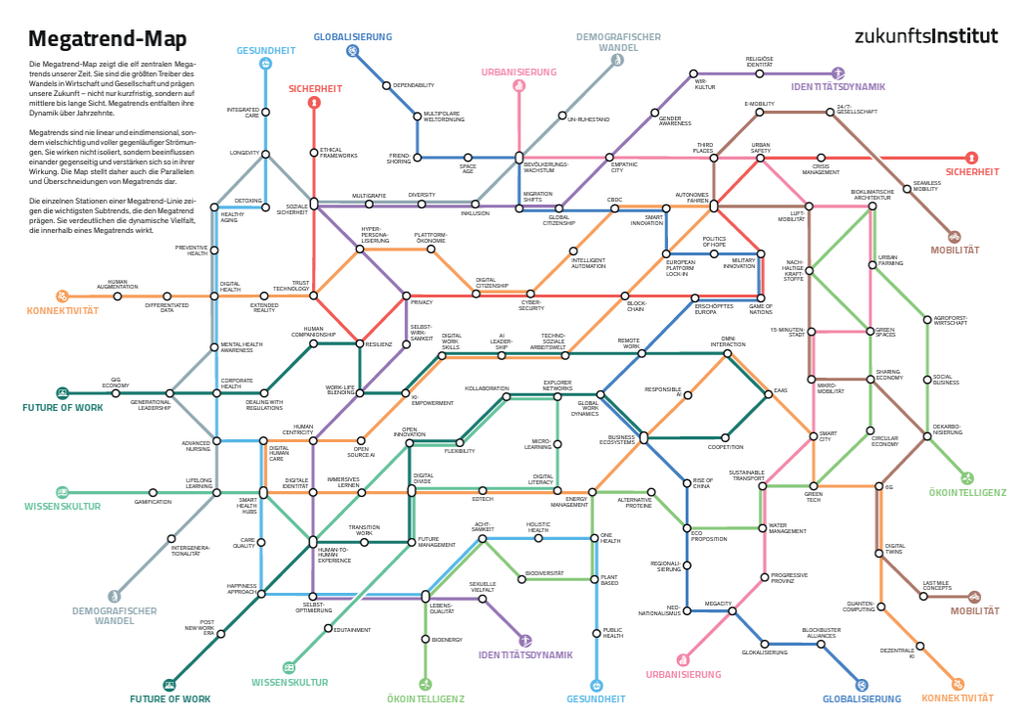
The current Zukunftsinstitut megatrend map identifies eleven broad forces: Demographic Change, Future of Work, Health, Globalization, Identity Dynamics, Connectivity, Mobility, Eco-Intelligence, Security, Urbanization, and Knowledge Culture. All of them can affect language work. Sustainable reporting creates multilingual terminology challenges. New mobility systems require localized interfaces and safety communication. Security concerns increase the need for trusted, confidential language workflows.
Five megatrends, however, have especially direct implications for the demand, workflows, and value proposition of language professionals: Connectivity, Globalization, Demographic Change, Knowledge Culture, and Health.
A practical framework from change to opportunity
Every megatrend sets off a chain reaction. First, a long-term force changes the environment. That change disrupts familiar roles, products, or workflows. The disruption creates a new need. Meeting that need creates an opportunity.
| Megatrend | Disruption | New need | Opportunity |
| Connectivity | Instant AI translation | Control and consistency | Language AI auditing |
| Globalization | More connected markets | Cultural relevance | Market adaptation |
| Demographic Change | More diverse audiences | Accessible communication | Inclusive-language expertise |
| Knowledge Culture | Explosion of AI content | Trust and verification | Multilingual validation |
| Health | Personalized healthcare | Clarity and trust | Health communication |
This framework prevents us from stopping at disruption. Disruption is real, but it is only the middle of the story.
1. Connectivity makes output abundant and governance essential
Connectivity links people, machines, platforms, and organizations in real time. Multilingual content now moves through websites, apps, support channels, meetings, videos, knowledge bases, and AI assistants at a speed no human production model could match on its own.
The obvious disruption is instant translation. When a draft can be translated in seconds, clients may assume that multilingual communication has become a commodity. Yet faster generation produces a less visible challenge: organizations must control terminology, tone, risk, and consistency across a growing number of systems. A sentence may be acceptable in isolation and still conflict with the product interface, the legal position, the brand voice, or another market’s version.
That creates opportunities for language AI auditors and language systems designers. Their work may include evaluating model output, defining quality criteria, building terminology and style assets, designing human review points, testing prompts, tracing recurring errors, and deciding when automation is inappropriate. The unit of value shifts from one translated text to the reliability of the multilingual system.
For language professionals, the strategic move is to learn how content flows. Ask where source text originates, which tools transform it, which data the system uses, where errors are detected, and who is accountable when communication fails. Linguistic judgment becomes more valuable when it is embedded upstream rather than added only at the end.
2. Globalization reduces some barriers while raising the stakes of relevance
Globalization is not a simple march toward uniformity. Markets, teams, and communities are increasingly connected, but local expectations remain powerful. In some contexts they are becoming more visible precisely because global content is so easy to distribute.
AI can reduce the mechanical barrier of converting words from one language into another. It cannot remove the need to understand what a message means in a particular cultural, commercial, and political context. A campaign that is grammatically correct can still feel imported. A product proposition can fail because it assumes the wrong level of trust, formality, humor, urgency, or familiarity. A global organization can use the same words in every market and produce very different reactions.
The emerging need is not merely translation, but local relevance. This creates space for cultural intelligence consultants, transcreation specialists, and market adaptation experts. They can advise on positioning before copy is finalized, test concepts with local audiences, identify reputational risks, and explain which elements should remain globally consistent and which should change.
This is an important repositioning. Instead of receiving a finished text and asking, “How should I translate this?”, the professional joins earlier and asks, “What does this market need to hear, and how should the brand express it here?”
3. Demographic Change turns accessibility into a core communication requirement
Populations are ageing, migration is reshaping communities, and audiences are becoming more linguistically and culturally diverse. At the same time, people interact with essential services through digital channels that often assume excellent vision, hearing, literacy, connectivity, and familiarity with institutional language.
The disruption is not one new technology. It is the growing mismatch between standardized communication and the people expected to understand it. An older patient may need plain language and a readable interface. A newly arrived resident may need an interpreter and culturally appropriate guidance. A deaf user may depend on accurate captions. A person with limited literacy may need information restructured rather than translated sentence by sentence.
The need is accessible, inclusive communication. Opportunities include plain-language adaptation, audio description, captioning, accessible localization, community interpreting, multilingual user testing, and communication design for older or underserved audiences.
Language professionals already possess an essential part of this expertise: the ability to anticipate misunderstanding. The next step is to combine linguistic knowledge with accessibility principles and user-centered design. The guiding question becomes not only whether the words are correct, but whether the intended person can find, process, and act on them.
4. Knowledge Culture makes trust scarcer than information
Knowledge has become one of the central resources of the global economy. Education, professional expertise, and organizational memory increasingly live in digital systems. Generative AI accelerates this development by making it possible to produce explanations, summaries, training materials, and answers in enormous quantities and many languages.
But an abundance of content is not the same as an abundance of knowledge. AI-generated material can be fluent and wrong. It may merge sources, omit qualifications, reproduce bias, or invent plausible details. When that material is translated automatically, the original uncertainty can be amplified while becoming harder to detect.
The new need is verification: someone must establish whether multilingual information is accurate, traceable, appropriate for its audience, and safe to publish. This opens opportunities for multilingual knowledge validators, AI evaluators, terminology curators, and experts who design evaluation datasets and review protocols.
These roles reward disciplined skepticism. A validator does more than polish style. They compare claims with authoritative sources, distinguish fact from interpretation, test whether terminology remains consistent across languages, and document uncertainty. In a world where content is cheap, accountable judgment becomes a premium service.
5. Health raises the value of clarity, empathy, and accountability
Health is moving beyond the treatment of illness toward prevention, digital monitoring, personalized care, and cross-border collaboration. Patients encounter information through portals, apps, telehealth appointments, medical devices, research platforms, and public health campaigns. Migration and medical travel add further linguistic complexity.
The disruption is a rapidly expanding volume of personalized, time-sensitive communication. A generic translation may no longer be sufficient when instructions depend on a person’s condition, device, literacy level, or care pathway. Errors can have consequences far beyond brand consistency.
The need is understandable and trustworthy health communication. Opportunities include specialized medical translation and interpreting, multilingual patient education, localization of digital health products, plain-language adaptation, validation of AI-generated health content, and communication support for informed consent.
Success in this field requires subject knowledge, careful risk assessment, and empathy. It also requires the confidence to define where human oversight is non-negotiable. Automation can support scale, but accountability cannot be delegated to a tool.
The common thread is a move from production to judgment
Across all five megatrends, the pattern is remarkably consistent. Machines make first-pass output faster and more abundant. Organizations then face new questions about control, relevance, inclusion, truth, and trust. Those questions are not peripheral to language work. They are where language expertise becomes most consequential.
This does not mean that traditional translation or interpreting will disappear. Nor does it mean every professional must become a consultant, engineer, or medical specialist. It means that relying on text production alone is increasingly risky. The strongest opportunities lie in combining language expertise with another layer of value: systems thinking, cultural analysis, accessibility, verification, domain knowledge, or strategic advice.

How to build future readiness now
Foresight is useful only if it changes what we do. The Institute for the Future has championed a mindset often described as urgent optimism: taking challenges seriously while retaining confidence that informed action can shape the outcome. For language professionals, future readiness can begin with three practical moves.
- Anticipate: Look beyond your current task list. Track changes in your clients’ audiences, content systems, risks, and markets. Notice recurring communication problems that no one owns yet.
- Envision: Translate your existing strengths into new roles. A terminology expert may become a language AI evaluator. A transcreator may offer market adaptation workshops. An interpreter may specialize in digital health or accessibility.
- Act: Run small experiments. Audit one automated workflow, take an accessibility course, create a multilingual evaluation sample, interview a client about emerging needs, or redesign one service around outcomes rather than word counts.
It also helps to choose a megatrend that genuinely interests you. The goal is not to add every fashionable skill to your profile. It is to identify one durable change, understand the needs it creates, and build a credible bridge from what you already know to the value clients will need next.
The future will still need language professionals
The language profession is not standing still. Familiar tasks are changing, some prices are under pressure, and AI is challenging assumptions about how multilingual content is produced. Those realities deserve an honest response.
But the future is not a contest between humans and machines for the same static job description. As technology and society change, the job description changes too. Connectivity creates a need for governance. Globalization creates a need for cultural relevance. Demographic change creates a need for accessibility. Knowledge culture creates a need for verification. Health creates a need for communication people can trust.
Our opportunity is to follow the chain all the way through: from megatrend, to disruption, to new need, to a service that solves a meaningful problem.
The most useful question is not, “Will AI take my job?” It is: “What will people and organizations struggle with next, and how can my language expertise help?”
If you would like to learn more about megatrends reshaping the language profession, you can join Eva Stiekema in her free session for International Translation Day 2026 “Megatrends shaping the future of language professionals”
You can register and join for free: https://www.proz.com/next/tv/International-Translation-Day-2026
Eva Stiekema is a dedicated translation professional with over 15 years of experience in the industry. Based in Cologne, Germany, she runs her translation service under the name Linguavision, offering comprehensive expertise across multiple fields, with a particular focus on marketing and IT.
Editorial notes:
- Image credits: AI-generated original supporting visuals created for this article.
- Sources: Based on the event presentation and megatrend research referenced there, including Zukunftsinstitut and the Institute for the Future.
0 Comments