
Guest post by Jason Willis-Lee
Jason Willis-Lee is a medical translator turned linguistic validation consultant with 26 years’ experience in
Spanish/French–English clinical trials translation. He teaches the full LV methodology in Mastering Linguistic
Validation in Multilingual Clinical Trials.
In short:
● What LV is: a measurement science discipline, not translation with extra steps
● Why it resists AI: regulatory chain of custody, real patients, human judgement on divergences
● What to do next: reposition your background, publish methodology content, and consider structured
training
Medical translation built your career. It gave you clinical vocabulary, a feel for regulatory language, and a
portfolio you’re proud of. But look honestly at where general-purpose MT and LLMs are heading, and you’ll see
the writing on the wall: straightforward medical translation – patient leaflets, generic clinical documentation,
standard consent forms – sits squarely in the blast radius of AI disruption. Clients already push back on rates.
Agencies already route more work through machine translation plus light post-editing. The segment that once
felt safely technical now feels exposed.
Linguistic validation (LV) sits in a different position entirely. It isn’t safe from AI because AI hasn’t discovered
it yet – it’s safe because the value it delivers can’t come from a model alone, no matter how good that model
gets. If you’re a medical translator wondering where your expertise still commands a premium in five years, LV
deserves your serious attention now, not after the market catches up with you.
The Problem With Staying Where You Are
Here’s the uncomfortable truth about generalist medical translation: buyers increasingly see it as a commodity.
A CRO project manager doesn’t wake up thinking “I need a medical translator.” They think “I need someone
who understands COA methodology, ISPOR standards, and FDA guidance from the inside out.” If your website,
your LinkedIn profile, and your pitch still lead with language pairs and per-word rates, you’re invisible to the
buyers who would pay premium fees without blinking – and you’re competing on the one dimension where AI
keeps closing the gap: raw linguistic conversion.
Most translators entered this market through language service providers and accepted whatever rate the agency
posted. Over time, agencies commoditise the work further, and translators who stay on this track spend years
getting more skilled while earning the same per-word rate they started with. Add AI-assisted drafting to that
equation, and the squeeze only tightens. The harder you work inside that model, the more margin someone else
captures.
Why Linguistic Validation Doesn’t Commoditise the Same Way
Linguistic validation isn’t translation with extra steps. It’s a measurement science discipline that happens to
require translation. When a patient-reported outcome (PRO) instrument crosses into a new language, the
question isn’t “did we translate the words correctly?” It’s “does this instrument measure the same construct, with
the same sensitivity, in this population as the original does in its own?” A score of seven has to mean seven in
every language. That’s not a translation problem. That’s a measurement problem, and measurement problems
need human evidence, not just fluent output.
That distinction is what keeps LV structurally resistant to AI substitution, for several concrete reasons:
It runs on regulatory frameworks, not just language quality. The Wild et al. methodology, ISPOR Good
Practices, FDA PRO Guidance (2009), and the EMA Reflection Paper on HRQoL translation all specify a
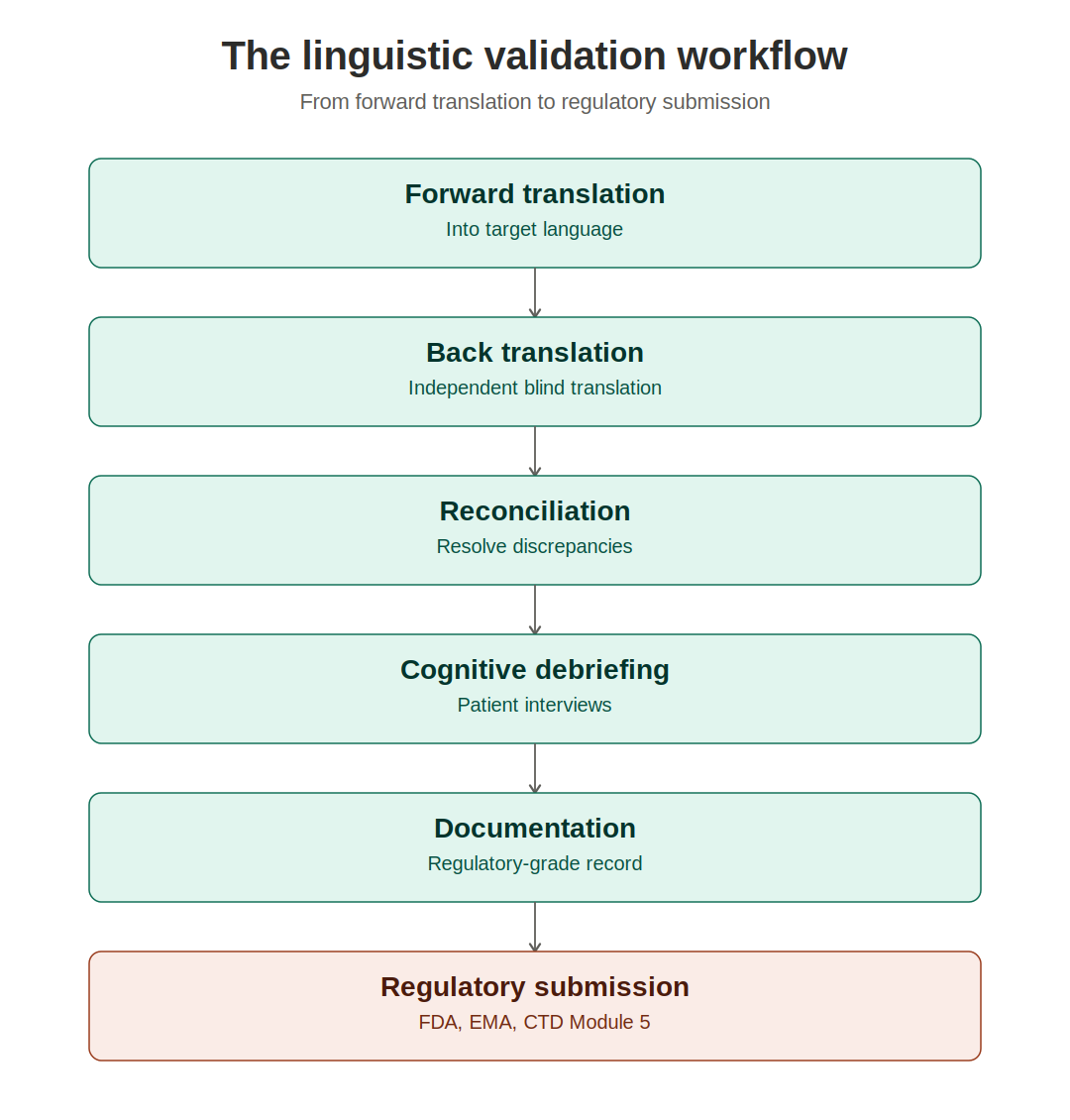
process – forward translation, reconciliation, back translation, cognitive debriefing, physician review, developer
approval – that produces documented, auditable evidence at every step. An AI model can draft a translation. It
cannot produce a defensible chain of custody that an FDA or EMA reviewer will accept as proof of
measurement equivalence.
Cognitive debriefing needs real patients in the room. This is the step that separates LV specialists from
medical translators, and it’s the step most agencies still outsource poorly. Cognitive debriefing (CD) is a
structured interview process with 5 to 15 native-speaking patients from the actual target trial population, a
trained, non-directive interviewer conducts, generating verbatim data on comprehension, relevance, and cultural
appropriateness. No model can sit across from a patient and probe whether trabajo habitual gets read as paid
employment only, or as any daily activity, the way real participants in a real interview did in one of the worked
examples from Mastering Linguistic Validation in Multilingual Clinical Trials. CD isn’t optional or
supplementary to LV – it’s the validation component that makes LV validation rather than translation. Any
framing of LV that treats CD as an add-on has already missed what makes the discipline valuable.
Back translation only works because it isn’t automated. Here’s a paradox most translators outside this space
get backwards: back translation isn’t a check on how well the forward translator did their job, and a back
translation that closely reproduces the original English is actually a red flag, not a quality mark. It suggests the
back translator has seen the source and been influenced by it. The whole analytical value of the step depends on
an independent, bilingual translator who has never seen the source instrument producing a genuinely blind
rendering. That independence, and the judgement needed to interpret the resulting divergences – semantic
expansion, specificity shift, no divergence at all – is a human process by design. Feed it to a model and you
break the very thing that makes it evidentiary.
The documentation is the deliverable. Every step in the LV cycle generates a specific evidentiary layer: the
translation core (preparation, forward translation, reconciliation), the developer signal layer (back translation
and review), the patient evidence layer (cognitive debriefing), and the developer approval gate. Together these
form the LV report – the document a sponsor submits to FDA or EMA as proof an instrument is fit for a global
trial. A single poorly documented divergence, one the developer can’t evaluate without asking for clarification,
can trigger a full reconciliation round and cascade delays across a 20-to-40-language programme. Clients aren’t
paying for words on a page. They’re paying for regulatory confidence, timeline reliability, and single-point
accountability across that whole chain – three things a model output, however fluent, cannot underwrite on its
own.
What This Means for Your Positioning
If you’re translating medical content today, you already hold most of the raw material LV specialism needs:
clinical vocabulary, regulatory literacy, and (for many of you) direct experience in a healthcare setting before
you became a translator. That clinical background isn’t a footnote on your CV anymore – in the LV market, it’s
your primary credential. Buyers working in clinical outcomes research want a counterpart who understands
endpoints, not just sentences.
The pivot itself has three stages, and they map neatly onto how any specialist builds authority in a niche market.
Know: get found by the right buyers. CROs post LV roles without the word “translator” appearing anywhere
in the brief, and pharma sponsors screen for methodology knowledge, not language credentials. This means
publishing where those buyers actually look, on the topics they actually search: methodology explainers (“What
cognitive debriefing actually tests”), regulatory breakdowns (“What the FDA PRO Guidance means for your LV
workflow”), process case studies, and glossary content most people never bother to write well. Most translators
publish nothing. The ones who publish even a handful of well-positioned pieces become the obvious choice by
default.
Like: build credibility through clinical depth and a genuine professional story. Being found isn’t enough –
buyers need to feel your thinking aligns with theirs. Demonstrate fluency in the ISPOR workflow and the
FDA/EMA landscape. Share the journey that brought you to LV, whether that’s a clinical setting, a first
validation project, or the moment the methodology clicked for you. People hire people, not profiles.
Trust: close without a sales pitch. Case studies that use clinical terms – therapeutic area, instrument, number
of languages, regulatory submission context – let buyers recognise themselves in your work. A single sentence
of social proof from a credible source does more than three paragraphs of self-description. And visibility in
professional spaces like ISPOR or ISOQOL places you in the same ecosystem as the people who hire you,
which builds trust faster than any portfolio page.
None of this happens overnight, but it doesn’t need to take years either. A realistic runway looks like 30 days to
reposition your website, LinkedIn profile, and first core content pieces; another 30 to publish a genuine lead
magnet and start reconnecting with past contacts on a value-first basis; and by day 90, the first inbound enquiry or discovery call as the compound effect of consistent publishing starts to work. Ninety days of consistent,
strategic effort will move you further than five years of waiting for the right agency to notice you.
Use AI as an Accelerator, Not a Threat
None of this is an argument against using AI at all – it’s an argument for using it in the right place. Inside an LV
practice, AI tools handle pre-editing, terminology checks, glossary validation, drafting support, and formatting.
What they don’t touch is the analytical judgement: classifying a BT divergence, designing a non-directive CD
probe, writing a resolution rationale a developer can defend to a regulator. If AI bakes the sponge, you still need
to put the icing on top. Practitioners who understand that division of labour, and who stay current on emerging
cognitive debriefing platforms entering this space, position themselves as future-ready specialists rather than
legacy service providers competing against tools that do their old job for free.
“But Isn’t LV Just a Smaller Market?”
Every translator who hears this argument for the first time raises the same objection, so let’s deal with it directly.
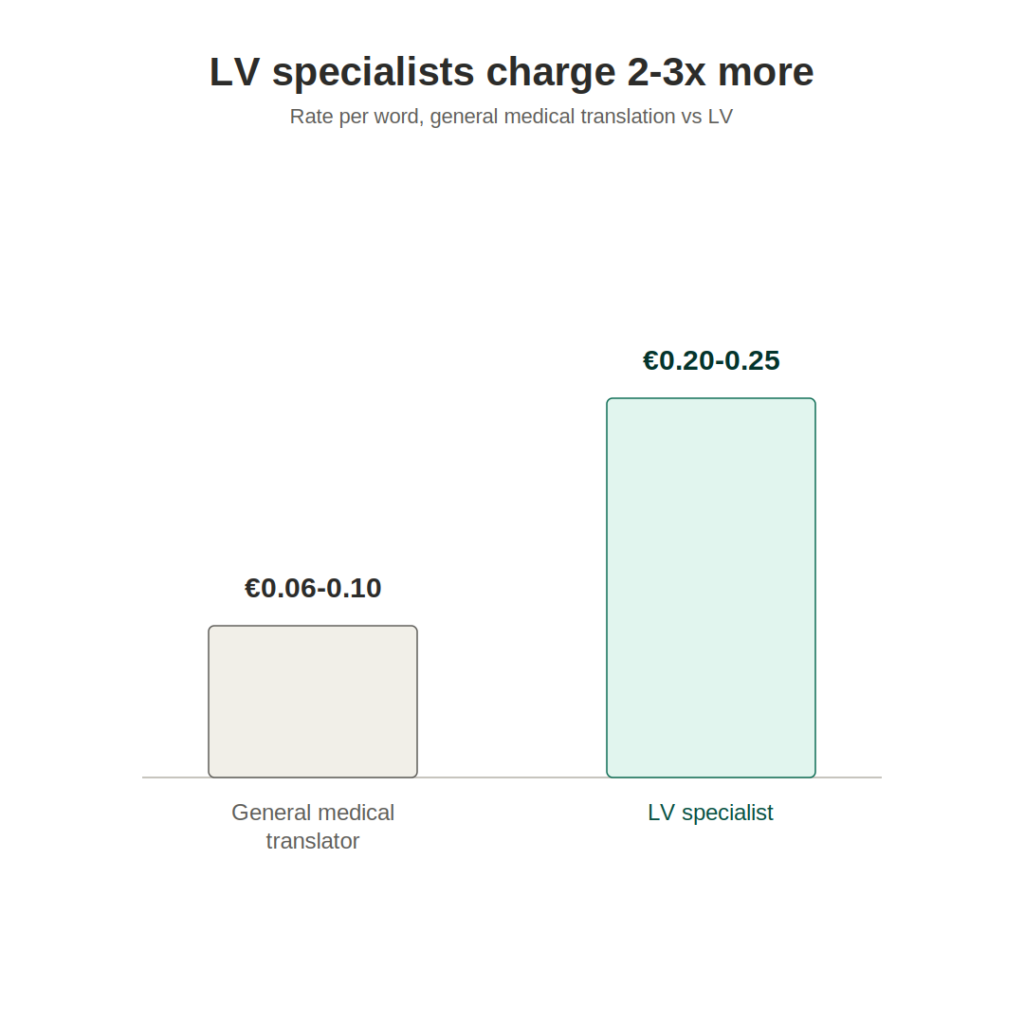
“There’s less volume in LV than in general medical translation.” True, but volume isn’t the metric that
matters – rate and repeat engagement are. A single global PRO instrument validation project routinely runs 4 to
8 weeks per language pair, involves 5 to 7 distinct specialists per language, and covers 20 to 40 languages
simultaneously on a major Phase III trial. That’s a multi-month, multi-specialist commercial engagement, not a
one-off per-word job. Agencies and sponsors pay accordingly, because they need specialists they can trust to
deliver to regulatory standard, not the cheapest bilingual reviewer available that week.
“I don’t have a clinical background.” Neither do plenty of successful LV practitioners starting out. What you
need is fluency in the methodology – Wild et al., ISPOR, FDA PRO Guidance, EMA reflection papers – and a
willingness to publish your thinking on these topics until buyers associate your name with them. Clinical
experience accelerates the pivot; it isn’t a prerequisite for starting it.
“Won’t AI eventually handle cognitive debriefing too?” Ask what CD actually verifies: comprehension,
relevance, and cultural appropriateness in the minds of real target patients, a trained interviewer captures
through non-directive probing, producing verbatim data that becomes part of the regulatory record. That’s not a
linguistic output problem a model solves by getting better at language. It’s an empirical evidence requirement
that only exists because real people, with real disease experience, sat in a room (or on a call) and answered open
questions from a trained interviewer. Regulators don’t accept synthetic patient data as a substitute, and there’s no
realistic near-term path where they will.
“This sounds like a lot of new process to learn.” It is, and that’s precisely the moat. That’s also exactly what
Mastering Linguistic Validation in Multilingual Clinical Trials walks you through, step by step. The steepness
of that learning curve is what keeps this niche from flooding the way generalist medical translation has. Every
hour you invest in understanding reconciliation, BT divergence analysis, and compliant CD reporting is an hour
a generalist translator – or a company selling MT-plus-post-editing – can’t easily replicate.
The Real Choice in Front of You
You can keep competing in a segment of medical translation where AI narrows your margin every year, or you
can move toward a specialism where the regulatory frameworks, the patient evidence requirements, and the
documentation burden all work in your favour rather than against you. Linguistic validation doesn’t ask you to
abandon your medical translation background – it asks you to reposition it as the foundation of something that
commands direct contracts with CROs and pharma sponsors instead of per-word rates set by agencies squeezed
from both directions.
The translators who make this move now, while the market still associates “LV specialist” with a small, credible
group of practitioners, will be the ones CROs already trust by the time everyone else notices the shift.
If this resonates, Mastering Linguistic Validation in Multilingual Clinical Trials walks you through the full
methodology – forward translation, reconciliation, back translation, cognitive debriefing – with worked
examples like the one above.
And if you want a free weekly dose of this mindset, sign up for Beyond Words.

Jason Willis-Lee
Business Development | Patient-Sided Research and Engagement | Medical Communications
Jason Willis-Lee is a medical communications specialist with 26 years of experience helping patients, clinicians and global stakeholders understand complex science with clarity, accuracy and compassion. His clinical training and clinical-trial translation background make him a natural fit for driving patient-centred engagement across the trial journey.
Jason trained in medicine at Bristol Medical School, which gives him a clinician’s instinct for patient needs, health literacy and emotional context. He has spent his career turning Spanish- and French-language clinical trial materials, medical reports and academic research into clear English – helping patients, caregivers and research participants make informed decisions they can trust.
Business Development Focus: Trust, Community and Engagement
Jason connects people with research that could change – or save – their lives. He now applies his medical and communication expertise to business development initiatives that strengthen:
- Patient education and clinical trial awareness
- Inclusive outreach and community-building
- Engagement strategies that honour diversity and reduce participation barriers
- Scalable, digital-first ecosystems supporting recruitment and long-term retention
He builds messaging and engagement pathways that make clinical research approachable, transparent and culturally relevant – core values at pXrEngage.
Online Community Building for Patient Engagement
Through his podcast Freelancer Training: How to Find More Direct Clients and his YouTube channel Freelance Translator Growth Mindset, Jason has built engaged online communities using evidence-based communication strategies, trust-building storytelling, email nurture sequences and behaviour-driven engagement funnels. He
now channels these skills into building patient-focused communities – helping life-science organisations communicate with warmth, clarity and credibility.
Alignment
Jason’s professional principles align closely with:
- Accessibility and transparency in clinical research
- Patient empowerment through empathetic communication
- Diversity, equity and inclusion in engagement
- Multichannel communities that support confident participation
- Trust between patients, families, clinicians and researchers
His blend of medical training, linguistic precision and digital engagement strategy positions him to drive business development and expand partnerships with sponsors, CROs and patient-advocacy organisations.
Background and Credentials
- Spanish–English and French–English medical translator (26 years)
- Over three years of medical training at Bristol Medical School, including hospital rotations
- BSc (Hons) in Physiology
- Former Clinical Research Associate
- Postgraduate qualification in Translation and Interpreting, University of Bath
- Founder, The Entrepreneurial Translator
- Host, Freelancer Training: How to Find More Direct Clients podcast
- Madrid-based | Globally engaged | Patient-first communicator
- www.entrepreneurialtranslator.com • www.jasonwillislee.com
0 Comments